Il 31 dicembre 2019 l’ufficio di Pechino della WHO, la World Health Organization, l’organizzazione dell’ONU che si occupa di sanità, venne informato di alcuni casi di polmonite scoperti nella città di Wuhan, nella provincia dell’Hubei, in Cina. Il 3 gennaio 2020 i casi accertati erano 44 e la causa, un nuovo tipo di Coronavirus, fu isolata il 7 gennaio. La sua sequenza genetica venne condivisa per scopi di studio il 12 gennaio: diventava ufficiale il COVID-19 (COronaVIrus Disease 2019). Il 13 gennaio il governo della Thailandia rendeva noto il primo caso di COVID-19 al di fuori della Cina, il 15 gennaio era la volta del Giappone.
Oggi il Giappone sta affrontando la terza ondata; i dati più recenti, al 22 novembre, danno 2.514 contagiati al giorno e 11 (undici) decessi. In Italia sono stati 34.764 contagiati e 692 morti.
Si dice che il nostro elevatissimo numero di morti – siamo il 6° paese al mondo per decessi totali, ieri eravamo il quarto – sia dovuto ad una popolazione con una età media molto elevata. Ebbene, l’Italia ha il 7,38% della sua popolazione con più di 80 anni (l’8,69% il Giappone) e 80 morti ogni 100.000 abitanti. Il Giappone ne ha 2.
C’è qualcuno, ente governativo, università, che sta facendo un’analisi seria delle prassi internazionali che si stanno dimostrando più valide nel combattere la pandemia, per provare ad adattarle alla condizione italiana, o stiamo semplicemente navigando a vista?
When the OHS management system has been designed and implemented for the first time, the activities that have been carried out to meet the requirement have probably been recorded, even if the standard does not deem it necessary. It is time to go back to these notes to evaluate what deviation has occurred in recent months, due to the consequences of COVID-19. In particular, it is possible that the policies, objectives and strategies implemented to achieve them have changed, because undoubtedly a new goal is the organization’s ability to survive the pandemic; this condition, however, will have seriously damaged the ability to pursue one’s objectives, because necessarily the prevention and protection measures that had to be implemented will lead to a reduction in production capacity and a collapse in productivity, at least in the short term.
In the following, information management has shown once again to be a critical aspect in the management of our organizations, to identify the methods for controlling the contagion to be implemented in the organization – therefore from the outside inwards – as well as for make workers aware of the new ways in which to carry out their work, and then internal communication. Risk control measures will probably require the introduction of new apparatus or services, and the modification of premises and equipment and the form of work performance, contracts, tenders, supplies, working hours, including shifts, and other working conditions. All this, ça va sans dire, will change, indeed, it has already changed relations with workers, their perceptions and values and the culture of the organization.
Similarly, as regards external factors, the pandemic condition has already profoundly changed the cultural environment and, perhaps, the market, depending on the characteristics of the various companies and at each of the international, national, regional and local levels they develop their business processes. The economic crisis that we are already perceiving is likely to have as a consequence the distortion of the pre-crisis reference market, with the disappearance of old and the coming to the fore of new partners and competitors, as well as the appearance of new professions, figures in charge of management and control of technical and organizational countermeasures against contagion. All of this will lead to significant changes in key factors and trends for the business sector and in relationships with internal stakeholders and their perceptions and values.
It will also be interesting to update the assessment of requirement 4.2 Understanding the needs and expectations of workers and other interested parties: probably, depending on the size of the organization, its territorial relevance and the one of the partners, new interested parties could be identified as, for example, local health emergency management and transport services, with new needs and expectations to be met.
On the basis of these new considerations, it will be necessary to evaluate the possibility of revising the scope of application of the health and safety management system, to introduce new processes such as, for example, the management of home-work transport. This basis will make it possible to redesign the processes of the management system, to adapt it to the new conditions in which the organization will find itself working: upon confirmation or redefinition of the policy statement, the definition of new roles, responsibilities and authorities for the system management and the new requirements for the exercise of leadership in the organization.
Sarebbe stato bello, in questa contingenza di #COVID19, avere un piano da seguire: avere definito i possibili scenari ed individuato le possibili contromisure, in maniera da non rendere necessario perdere tempo a per mettersi d’accordo, quando i contagiati raddoppiano ogni dieci giorni, ma forse ogni sette o ogni cinque.
Does an organization that has implemented an OHS management system according to the ISO 45001:2018 standard, needs to learn a lesson from what happened to it, because of the COVID-19 epidemic? Certainly. The decision to adopt a management system is made on a voluntary basis; there are no laws that impose it. Those who have taken this step did so because they intended to undertake a virtuous path, which detaches them from the ground of the minimum regulatory requirements defined for the protection of the psychophysical integrity of the worker, with the aim of accessing a higher level of good practices. And it is certainly a good practice to evaluate what has changed since December 31, 2019, when the World Health Organization collected a statement from the Municipal Health Commission of Wuhan, in the People’s Republic of China, relating to cases of viral pneumonia.
To be precise, the management system should have given itself a process for controlling the change, even if the requirement 4.1.3 foresees the need to keep under control the planned changes, temporary and permanent, which have an impact on the performance of the OSH. in terms of organization and working conditions, however, there remains a need to re-examine the consequences of involuntary changes.
We are therefore in the situation in which our organizations have had to take countermeasures in a hurry as a result of the epidemic, very often under impromptu instructions, and must now plan a coexistence with the virus that is expected to be long and complicated. How to operate to make the most of the management system? The most powerful tool in this regard is the management review, defined in requirement 9.3 of the standard. This is a step that usually marks the conclusion of a Deming cycle and the start of a new one, but nothing prevents it from being used for a new planning of activities, as a consequence of an epochal event such as the one we are experiencing.
In this case, the main topic to be evaluated is listed under letter b) of the content list of a typical management review: changes in internal and external factors that are relevant to the management system for OSH. And then we return to requirement 4: the context of the organization.
Tra criticità legate alla privacy, complessità dei dispositivi normativi e barriere tecnologiche, il tracciamento è una delle questioni più difficili nella gestione della pandemia. Come si muove l’ISS e cosa si potrebbe fare?
Com’è nata e cresciuta la mappa del coronavirus in Italia di Lab24 La pagina è partita con una mappa per allargarsi a grafici con dettaglio provinciale, rapporto tra contagi e tamponi, confronto internazionale. Sempre in dialogo con i lettori, di Luca Salvioli.
La situazione è eccezionale e irripetibile, come si è detto tante volte. Cerchino, tutti quelli che hanno responsabilità politiche, di essere all’altezza e non solo chiederlo agli italiani.
Fin dall’inizio, la comunicazione si è mostrata un elemento strategico per la gestione della pandemia, a tutti i livelli. Per le lunghe settimane di marzo, aprile e maggio, fino a che la curva dei contagi prima, e dei morti poi, hanno iniziato a tendere verso il basso, tanti italiani angosciati hanno atteso la conferenza stampa delle 18, quando la protezione civile comunicava i dati della giornata. Comunicare significa letteralmente rendere comune, condividere, e quindi non ci si riferisce solo alle informazioni, alle nozioni di utilizzazione pratica. Si condividono anche gli stati d’animo, le paure e le speranze. C’è un registro formale, che procede attraverso canali ben identificati e tenuti sotto controllo, ma c’è anche quello informale, che un’organizzazione, ma anche un professionista, devono tenere sotto controllo, perché può supportare, o affossare irrimediabilmente, il contenuto che con tanta fatica si è predisposto per il registro principale.
Cosa dire, però, di coloro che hanno mostrato la loro ingenua impreparazione alla guida della cosa pubblica? A prescindere dai contenuti degli atti di governo, in un contesto sociale la comunicazione informale che ha origine negli atteggiamenti mostrati dai leader ha grande influenza nei comportamenti adottati dal pubblico: mostrarsi apertamente refrattari alle misure necessarie al contenimento della pandemia, l’uso della mascherina, il mantenimento delle distanze, anche solo in occasione di riunioni e conferenze stampa, così come quando si viene ripresi circondati da collaboratori, ha fatto passare il messaggio informale che la situazione non è seria e che quindi non è il caso di preoccuparsi delle precauzioni. Un comportamento appena un ette meno grave di quello dei demagoghi.
Leggi l’articolo sul supplemento del numero 8-9/2020 di Igiene & Sicurezza del Lavoro.
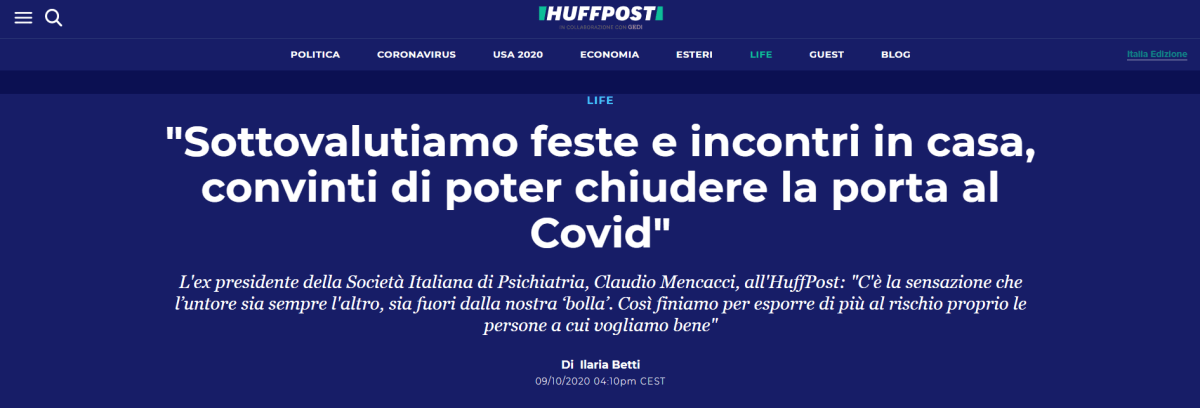
Claudio Mencacci, medico psichiatra, Presidente della Società Italiana di Neuropsicofarmacologia e Past President della Società Italiana di Psichiatria, prova a spiegare cosa accade nella nostra mente. Cosa ci spinge ad organizzare una festa in famiglia “a cuor leggero”, cosa ci induce – proprio mentre siamo lì tranquilli a bere un cocktail al compleanno del nostro migliore amico – a considerare il pericolo del Covid lontano. Anzi, lontanissimo.
In Italia abbiamo la mania di usare la lingua inglese, per sembrare più fichi, più cool. Il “#Recoveryfund”, questo strumento finanziario mitologico che inonderà la nazione di danari per risolvere tutti i nostri problemi non si chiama, in effetti “fondo per la #ripresa”; il suo nome ufficiale è “Next Generation EU”. In effetti, intitolare un fondo per la ripresa alla prossima generazione dell’Unione Europea è una scelta che la dice lunga sugli obiettivi che dobbiamo porci: come vogliamo lasciare l’Europa ai nostri figli? Next Generation, dice la Commissione, si basa su tre pilastri. Il primo è quello di sostenere la ripresa degli stati membri, attraverso programmi specifici come rescUE, per rafforzare la risposta alle calamità naturali delle strutture di protezione civile, REACT-UE, per le politiche di coesione per un recupero sostenibile e digitale. Il secondo è rilanciare l’economia e sostenere gli investimenti privati, con InvestEU, il nuovo programma per incrementare finanziamenti su crescita e occupazione. Il terzo pilastro è trarre insegnamenti dalla crisi.








 No PPE, no access beyond this point