Pubblicata la registrazione del webinar di martedì 2 febbraio 2021
Nel luglio scorso, l’ISO (International Organization for Standardization) ha rilasciato lo standard ISO/TS 24179:2020 “Human resource management — Occupational health and safety metrics”, “Gestione delle risorse umane – Metriche di salute e sicurezza sul lavoro”. Il nuovo standard definisce le formule per il reporting interno ed esterno per ottenere misure comparabili per il monitoraggio e la misurazione delle prestazioni relative alla salute, sicurezza e benessere dell’organizzazione. La norma enfatizza le questioni che devono essere considerate nell’interpretazione dei dati, in particolare quando si specificano azioni o misure correttive o per affrontare opportunità e quando si comunicano a stakeholder interni (come lavoratori e partner) o esterni (come investitori e autorità di regolamentazione).
Fish, according to popular wisdom, always rots from the head down. Consequently, regulations and standards insist on the involvement of top management in all business dynamics related to safety. Undoubtedly, top management defines the entire company policy, and therefore also that of safety. It establishes plans and programs for the future development of the organization, and it allocates resources. Making the long story short, top management makes the choices for the company’s strategy, in that never ending war which is the conquest of the market. Safety is just one of its various aspects; its relevance within the overall strategy of the organization can derive, for example, from the necessity to comply with the laws. However, this is the minimum degree; this kind of attitude will quickly present major limitations. For some divine curse, in fact, the law identifies the minimum expected behaviour to obtain a result, however, which is always the maximum: the complete protection of the psychophysical integrity of the worker. It is like a paradox of ancient Greek philosophy, whereby it is possible to reach the goal only when you decide to overcome it, which means that full compliance with the requirements of the standard can only be achieved by considering having to go beyond those.
When planning a goal of this kind, there is no need to be frightened by ethical considerations: there are markets in which the safety of workers and the protection of the environment are held in high regard, and companies that fail to take care of them cannot enter or have a short life. These are all those in which organizations are exposed to the action of large pressure groups, which may be such because they are made up of numerous subjects, such as consumer associations, or because they have great capacity for action, such as banks. For companies that decide to compete in these markets, complying with the law is only a starting point, because they know that their ability to do business will be greatly affected by the reputation they will be able to earn.
Once the management of an organization has defined the extent and objectives of its effort, whether it should limit itself to just obtaining compliance with legal standards, clearly for fear of the punishments that may be incurred, or whether it wants to go further, perhaps to access more profitable markets, it will have to adopt strategies to maximize the economical return. In this situation, we are led to focus on the technical and regulatory aspect, neglecting that the tendency of human groups to adapt to the messages and concrete behaviours of leaders, is an aspect that techno-geeks lead to underestimate. All this within any kind of organization, no matter how extensive, because the same dynamics present in any social sphere apply. A health, safety, and environment plan should therefore assign some resources to these issues, defining a communication strategy that has in the company management and in other leadership roles, such as elderly workers with respected experience, or young technicians of recognized competence, its own active testimonials.
The goal of an HSE communication strategy is undoubtedly to reinforce the importance of this aspect, in the eyes of all members of the community-organization, and it is pursued:
Adopting widespread behaviours of compliance with the rules.
Giving open support to those who respect them and to those who are committed to their control.
Recalling anyone who does not respect these rules, in a constant and irrelevant way of the role they occupy in the organization.
Informal behaviours of peers and superiors have a great influence on the perception of how health, safety and environmental protection are taken into consideration in the workplace: in small and less structured companies, the management is close to production activities, so it must be directly involved in these tasks. In the more structured ones, it will be appropriate to plan public initiatives, to make explicit the support of the management.
These can be, for example, periodic inspections conducted by top management in the production areas, together with the safety manager and the department managers, to be able to promptly intervene on the conditions encountered, naturally respecting the rules in force, such as the use of PPE, the smoking ban, respect for transit and safety areas… These inspections should be conducted with a frequency such as to avoid any kind of preventive staging, so to show the working conditions as they actually are every day and to ensure the workers on the sincerity of the objectives.
To obtain the maximum result, it is advisable to implement a communication campaign: a program, and resources, for at least one year, will avoid the counterproductive effects due to the silent renunciation of any initiative, because no plan was made. The elements of the campaign may concern, for example:
Incentive campaigns for the virtuous behaviour of workers, with bonuses paid directly to them or – better – money sums set aside by the company for social objectives, agreed with the workers themselves or their representatives.
Periodic campaigns on issues relating to safety and the environment, perhaps with objectives related to work, such as cleaning an area, the maintenance of a machine.
La pandemia è diventata un acceleratore del lavoro agile. Perché non approfittare di questa opportunità? Questo è un elenco dei corsi che ho elaborato più di recente, se ce n’è qualcuno che è di tuo interesse segnalamelo. Io poi mi metterò in contatto con te per inviarti approfondimenti e per definire i dettagli, inclusa la possibilità di personalizzarlo secondo le tue esigenze o quelle della tua organizzazione.
Per tutti i corsi è possibile ottenere gli attestati di partecipazione come aggiornamento per CSP/CSE, RSPP, formatore, secondo gli Accordi Stato Regioni, come Formatore Qualificato Locale AIAS.
L’internazionalizzazione è una realtà. L’economia non conosce frontiere e la necessità di inviare i lavoratori in missione all’estero, per durate più o meno brevi, è ormai una condizione comune a tante aziende italiane, di tutte le dimensioni. Le occasioni possono essere diverse: incontri di affari, nuovi stabilimenti, partecipazione a società locali, cantieri di costruzione, installazione o manutenzione di impianti. Il modo in cui gestire la sicurezza dei lavoratori impegnati all’estero può diventare un problema, e l’attuale pandemia di COVID-19 ha contribuito a complicare le cose.
Le fonti di informazione
Il primo passo per pianificare una missione all’estero è quello di fare una ricognizione delle leggi in vigore nel paese da visitare.
Valutazione dei fattori legati al sito
Una volta definito il panorama normativo, è necessario informarsi sulle condizioni locali che possono impattare sulle nostre attività: sicurezza personale, regime dei visti e dei permessi di lavoro, profilassi e vaccinazioni obbligatorie e consigliate, situazione sanitaria e possibilità di comunicare con l’estero.
Safety e security
Occorre considerare che la giurisprudenza ha iniziato a considerare rientranti nel perimetro delle responsabilità aziendali i rischi cui sono esposti i lavoratori all’estero in conseguenza dei viaggi e della presenza in aree con problemi di ordine pubblico, per non dire in zone di guerra. La cosiddetta “Sentenza Bonatti”, che nel gennaio del 2019 ha condannato i vertici dell’impresa di Parma per “cooperazione colposa in delitto doloso” per la morte di due dipendenti italiani rapiti in Libia, in questo caso ha fatto scuola.
La trasferta e il soggiorno
In ogni caso, anche nei paesi più tranquilli, l’azienda che invia lavoratori in trasferta dovrebbe pianificare i viaggi in modo da mantenere il contatto con i lavoratori in missione. In generale nella scelta del mezzo di trasporto le mere considerazioni economiche dovrebbero passare in second’ordine rispetto alla sicurezza del viaggiatore.
Alberghi e alloggi
Per missioni di breve durata, il soggiorno dovrà fare riferimento ad alberghi o altro tipo di ospitalità privata. La scelta dell’hotel deve essere improntata a criteri di igiene dell’alloggio e del vitto: in questo caso le grandi catene internazionali sono una relativa garanzia, anche nei paesi con gli standard più bassi. Nelle zone con problemi di ordine pubblico il consulente per la security potrà indicare quali sono le aree in cui è possibile alloggiare e quali quelle da cui è meglio tenersi a distanza, questione da tenere in considerazione anche nell’eventualità le persone in trasferta vogliano fare un po’ di turismo nel tempo libero, e visitare il luogo in cui si trovano.
Informazioni al personale
Lavorare in un paese straniero significa doversi confrontare con leggi e con mentalità che possono essere anche molto lontane da quanto siamo abituati, e solo persone con spiccate doti di apertura mentale e di flessibilità dovrebbero essere scelte per queste attività. Questa valutazione non è motivata solo da aspetti etici; ci sono importanti conseguenze pratiche in cui un’organizzazione può incorrere solo perché ha mandato la persona sbagliata nel paese sbagliato: rescissioni di contratti, ma anche incidenti, omicidi e arresti, causati da un approccio improvvido alle sensibilità dei locali, sono avvenuti in passato, e quindi potranno accadere anche in futuro.
Gestione delle emergenze
Un tema imprescindibile del lavoro all’estero è la necessità di potere fornire assistenza sanitaria ai propri lavoratori in qualsiasi momento, per cui la scelta di una assicurazione sanitaria internazionale è fondamentale. L’offerta ospedaliera nel mondo è molto varia, e le condizioni in cui questa viene erogata possono essere estremamente differenti da quanto noi siamo abituati.
Rapporti con le autorità locali
Quando la missione inizia a prendere consistenza, magari con l’apertura di un ufficio e la presenza continuativa di personale espatriato, è il momento di studiare come individuare e prendere contatto con le autorità locali che possono essere rilevanti per le attività svolte. Chiedere un incontro per presentarsi è una cosa che susciterà il loro apprezzamento, tantopiù se ci si trova in un’area remota, magari scarsamente popolata, dove anche la presenza di un piccolo gruppo di “forestieri” fa notizia.
Il COVID-19
Il COVID-19 ha introdotto una ulteriore criticità nella programmazione delle missioni dei lavoratori italiani all’estero. La pandemia ha investito tutto il mondo, ma il contagio si è sviluppato con modalità differenti in tempi differenti a seconda del paese. Ulteriori fattori di complicazione sono anche in modo in cui ha risposto sistema sanitario dei vari stati, nonché la capacità di raccogliere e processare le informazioni, unita ad una certa volontà politica di divulgarle o, al contrario, di mantenerle riservate.
Puoi leggere l’articolo completo sul numero 12 del 2020 di Igiene & Sicurezza del Lavoro.
It has been said that, in recent years, great progress has been made in the safety of work environments and equipment, as well as in the materials used. We have devised increasingly refined rules on how to organize companies, work environments, work processes and their interrelations, on how to train workers in various activities.
Sometimes, this effort was not matched by a similar decrease in accidents and injuries. The weak point seems to be the human factor: every now and then, workers are their own main enemies, because they resist the adoption of good safety practices in the workplace.
The worker, consciously or unconsciously, can engage in behaviours that result in little or no support for good safety practices. One of the most relevant issues in this respect is the relationship with the hierarchy, with the employer.
The worker, at times, develops a feeling of misunderstood loyalty with the employer which, often in small organizations, is perceived as “close”. These are those conditions in which, for example, safety is seen as a productive and economic burden, and the worker lends himself to relieving the employer, in part or in whole, of this burden. Often the company, the organization, is perceived as an extension of the family, and laws, regulations, and inspections, are seen as something that disturbs their tranquillity. For example, there are known cases of workers reluctant to apply for recognition of an occupational disease because of exposure to asbestos, given that they have developed a friendship with their employer for decades. Of course, the process by which safety is treated as a trivial matter, and of little importance, can take place in the good faith of the employer, with the misunderstanding of the informal messages it sends out. If the employer is more inclined to make observations relating to the time taken to work or to complain about the economic weight of running a business, and never reminds his collaborators to comply with safety regulations, it is normal that the latter are more careful to improve their work performance, rather than following the rules for safe execution.
Not to mention the messages that are explicitly issued by the employer or by the entire hierarchical chain: the underestimation of the dangers, the commiserating devaluation of everything concerning safety in the workplace, such as people, PPE, rules, are a tremendous example.
Returning to workers, the older or more experienced ones can sometimes refuse to adopt safe working practices for two reasons: the first is when it comes to the introduction of new activities, equipment or procedures, due to the natural resistance to innovation that characterizes the majority of people. But the problems may also be due to the claim, widespread among the most experienced workers, that their experience or the skills they have achieved can give them better control of operations. This is the reason for several accidents, due to lightness, to the fact that it was decided to follow a shortcut with respect to ordinary practice, to impromptu changes made on equipment and machines.
At the other end of the experience, younger and less experienced workers are prone to lukewarmly accepting safety practices in the company because they are still disoriented, due to their lack of experience in the tasks and in the workplace: they have not yet evaluated the “measure” with which to relate in the company; whether their attitude will be considered acceptable or will they be regarded as troublemakers. The low evaluation they have of themselves is also relevant, especially when they are at the beginning of their career and occupy the humblest jobs: they consider any working condition acceptable, especially in conditions of joblessness, with gratitude because, precisely, they must gain experience.
A relevant aspect of the opposition, open or creeping, of workers to the use of good safety practices is a consequence of a recurring condition in human groups: the herd effect, when the personal critical capacity is completely cancelled while waiting for orders. And since a significant part of the behaviours that can be observed in the workplace can be the consequence of informal messages such as conducts, which workers observe or infer from company management, it becomes essential for this to be aware of the importance of behaving in public consistent with the objectives of the organization’s policy, considering that every occasion is important to give a message.
Clearly, it is the responsibility of the company management, in planning related to the OHS management, to bear in mind that these factors can have a heavy impact on the result. Whether the goal is the minimum, that is, compliance with the law, the more so if more ambitious goals are set.
Nella foto: Settembre 2013, i lavori di ampliamento sotto traffico della galleria Montedomini sull’Autostrada A14.
La decisione di intraprendere il percorso di costruire o modificare i propri processi di business in relazione ai requisiti dello standard ISO 45001, se non addirittura di puntare alla certificazione del sistema di gestione per la salute e la sicurezza, è una questione che può impegnare anche in maniera rilevante il presente ed il futuro prossimo delle organizzazioni che affrontano questo passo. Una valutazione delle risorse da utilizzare per la costruzione e per garantire il funzionamento del sistema di gestione è doverosa, soprattutto perché il pericolo è quello di lanciarsi in un’avventura senza avere la concreta possibilità di raggiungere gli obiettivi che ci si pone. Il capitolo 7.1 Risorse dello standard definisce i requisiti da rispettare, intese come le persone dedicate al sistema di gestione, ma anche infrastrutture (locali, attrezzature, mezzi di trasporto), in termini abbastanza generici, sufficienti però ad indirizzare l’analisi su quello che efficacemente contribuisce al successo del sistema di gestione. Alcune di queste specifiche, in particolare quelle relative alla competenza delle risorse strategiche per le prestazioni del SSL, vengono approfondite dai capitoli successivi.
Quali risorse
Occorre però considerare che l’accesso alle risorse più appropriate, potrà influenzare non solo il modo in cui il sistema di gestione sarà amministrato, ma anche e soprattutto come esso sarà progettato e determinati i suoi obiettivi. Nei sistemi di gestione costruiti secondo L’High Level Structure – il modello per questi standard elaborato dall’ISO – l’analisi del contesto dell’organizzazione definita dal capitolo 4, con le due specifiche relative alla comprensione dell’organizzazione e del suo contesto e alla comprensione delle esigenze e delle aspettative dei lavoratori e di altre parti interessate, è il momento in cui vengono definiti gli obiettivi, individuati i mezzi necessari e vengono analizzati quelli in possesso dell’organizzazione stessa. Onde evitare di eseguire analisi superficiali, che inevitabilmente impedirà di ottimizzare gli obiettivi, costruendo un sistema di gestione lontano dall’ottimizzazione dei processi, sarebbe opportuno assicurarsi il supporto di una persona esperta, esterna all’organizzazione per il supporto a queste attività. L’assenza del coinvolgimento nelle dinamiche interne dell’organizzazione, nonché l’attribuzione di un incarico ben definito e limitato al supporto per la progettazione del sistema di gestione, dovrebbero essere la garanzia di un punto di vista distaccato ed imparziale, e perciò funzionale agli obiettivi dello standard.
Leggi l’articolo ISO 45001: impossibile senza risorse adeguate sul numero 11/2020 di Ambiente & Sicurezza.
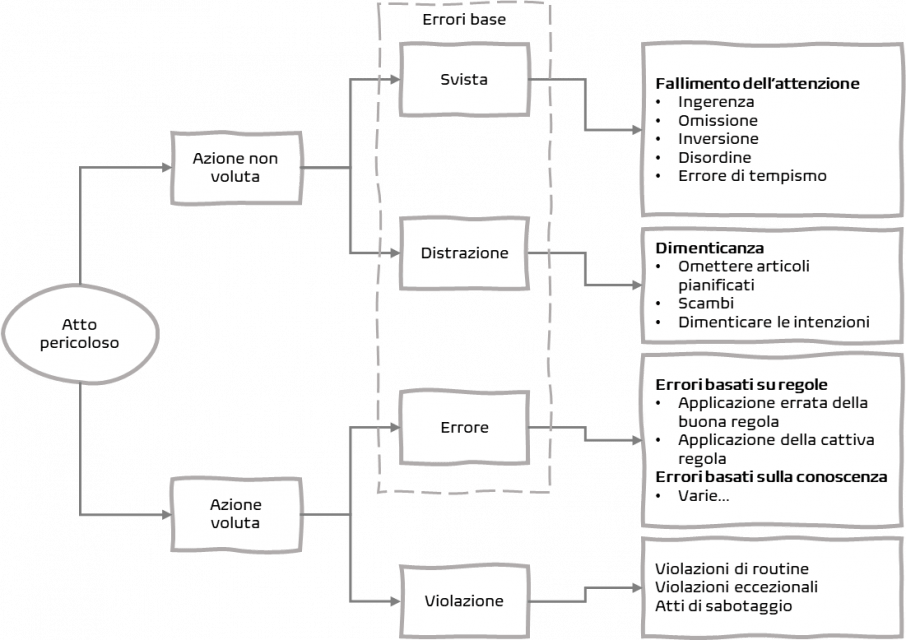
L’atto pericoloso, dice Reason, può essere voluto o non voluto. Gli atti involontari possono essere classificati in sviste, distrazioni o errori, a seconda di come si è generata la deviazione. È una svista quando si scambia un’azione per un’altra, evidentemente per un deficit dell’attenzione. Quante volte siamo usciti di casa prendendo il mazzo di chiavi sbagliate, ad esempio? O abbiamo preso l’attrezzo sbagliato dal bancone, fidandoci della memoria della sua posizione? Si tratta di una dimenticanza, invece, quando, letteralmente, dimentichiamo uno o più passi di un particolare procedimento. O, magari, quando, a metà del lavoro ci rendiamo conto di avere perso di vista l’obiettivo con cui avevamo iniziato.
La cultura della sicurezza è il potente strumento che è necessario per affrontare e risolvere i problemi tecnici e organizzativi, e per garantire il mantenimento delle buone condizioni di lavoro raggiunte.
Il leader è quello che riesce a distinguersi per la capacità di coinvolgere e motivare: guardate come un capo si relaziona con i suoi e scoprirete se è un leader.
Il sistema definito dal D.Lgs. 758/94 (contestazione, foglio di prescrizione, ammissione al pagamento) ha un unico, enorme difetto: ha annullato il confronto. Di fatto, l’unico modo per presentare le proprie ragioni, avverse ad un foglio di prescrizione, è non ottemperare e andare al processo. E chi è che, pensando di avere ragione, decide di partire con un processo penale, che secondo Il Sole 24 Ore dura mediamente 1600 giorni, quando accettando di seguire una prescrizione dei tecnici dell’ASL se la potrebbe cavare con una sanzione di qualche centinaio di euro, nei casi più gravi qualche migliaio? Il guaio è che, eliminando il confronto, si è persa una importante opportunità di crescita professionale, dei tecnici e dei datori di lavoro come degli UPG. Non si è dato modo di selezionare una classe professionale sulla base della reale capacità di sapere rispettare la legge, i datori di lavoro si cullano nella pretesa imprevedibilità delle sanzioni, che sembra capitino slegate da ogni criterio di effettività delle violazioni, gli UPG, raramente messi alla prova, vacillano tra una pretesa infallibilità e l’aderenza a pratiche minimali. Naturalmente al netto di casi di eccellenza, che sono presenti in ogni categoria.











 No PPE, no access beyond this point