Il leader è quello che riesce a distinguersi per la capacità di coinvolgere e motivare: guardate come un capo si relaziona con i suoi e scoprirete se è un leader.
Leggi il post su HSE Manager Wolter Kluwers Italia: Leader e capi | LinkedIn
Il blog
Italia, Giappone e COVID-19 – numeri a confronto

Il 31 dicembre 2019 l’ufficio di Pechino della WHO, la World Health Organization, l’organizzazione dell’ONU che si occupa di sanità, venne informato di alcuni casi di polmonite scoperti nella città di Wuhan, nella provincia dell’Hubei, in Cina. Il 3 gennaio 2020 i casi accertati erano 44 e la causa, un nuovo tipo di Coronavirus, fu isolata il 7 gennaio. La sua sequenza genetica venne condivisa per scopi di studio il 12 gennaio: diventava ufficiale il COVID-19 (COronaVIrus Disease 2019). Il 13 gennaio il governo della Thailandia rendeva noto il primo caso di COVID-19 al di fuori della Cina, il 15 gennaio era la volta del Giappone.
Oggi il Giappone sta affrontando la terza ondata; i dati più recenti, al 22 novembre, danno 2.514 contagiati al giorno e 11 (undici) decessi. In Italia sono stati 34.764 contagiati e 692 morti.
Si dice che il nostro elevatissimo numero di morti – siamo il 6° paese al mondo per decessi totali, ieri eravamo il quarto – sia dovuto ad una popolazione con una età media molto elevata. Ebbene, l’Italia ha il 7,38% della sua popolazione con più di 80 anni (l’8,69% il Giappone) e 80 morti ogni 100.000 abitanti. Il Giappone ne ha 2.
C’è qualcuno, ente governativo, università, che sta facendo un’analisi seria delle prassi internazionali che si stanno dimostrando più valide nel combattere la pandemia, per provare ad adattarle alla condizione italiana, o stiamo semplicemente navigando a vista?
The management of HSE documentation in construction companies – HSE People

Document management is a critical aspect in HSE systems in all kind of companies and especially in construction ones. Even more so, if they follow a management system, certified according to BS OHSAS 18001:2007, the new ISO 45001:2018 or ISO 14001:2015. Construction companies have the peculiarity that often their organization is temporary, linked to the needs of individual projects, and they have a weak supervision of corporate processes. This means that, even the big players, design the documentation management systems of their projects more according to the skills of the individual managers who have the good fortune to recruit, rather than because of well-considered corporate decisions. In the long run, this is proving to be a factor of weakness of these organizations, especially when they find themselves competing in the international market, where other organizations have made radical choices in this regard some years already.
Which documents
The management of documentation relating to safety and the environment in a construction company can be declined in various aspects; the main one concerns the ordinary management of documents functional to the definition of the company management system, their distribution, storage and withdrawal, in particular, of:
- policies;
- manuals;
- procedures
Then there are the records of the activities defined by company policies and procedures, such as:
- risk assessment;
- training;
- health surveillance;
- monitoring and measurements in the workplace;
- accident and injury investigation;
- internal reporting.
Policies and procedures can concern production, with the provision of instruments to organize and control key activities such as, for example:
- use, management and maintenance of machines and equipment;
- work permits;
- hot works;
- work at height;
- work in confined spaces.
- atmospheric emissions and discharges;
- waste management;
- noise;
- storage and use of hazardous materials.
Letters and communications of various kinds are also to be considered. For contracted activities, it is almost normal practice for the client to ask to be informed about plans and business processes, sometimes going so far as to subordinate the contractor’s operations to his approval of these. Furthermore, in these cases, the sharing of on-site monitoring data, letters and periodic reporting is a common practice.
Organization of the company and organization of the project
A company of this kind organizes its activity by projects, which means that the management of the documentation, its distribution, the collection of records and the reporting must have a first synthesis at this level, but must also be coordinated in more areas, department, territorial and corporate units.
Normally this type of activity is managed through the formal preparation of a set of more or less in-depth information, the actual application of which and the relative administration of records and reports is carried out with different degrees of informality which, it must be said, entail as many degrees of inefficiency. In recent years, however, the development of particular software platforms for sharing information and an increased need for competitiveness of companies, if not the specific requests of particularly professional clients, has led many of these to think about the adoption of PLM (Product Lifecycle Management) platforms, identifying the management of information related to the development of the project as a strategic factor for the success of the project.
A company that intends to equip itself with a tool of this kind, starting from the assumption that it has already implemented a management system, should first of all check the degree of formality with which this is applied: although PLM platforms have dramatically evolved in recent years in terms of simplicity and user-friendliness, their use still involves a certain level of discipline in the company. For an organization that manages its processes widely in an unofficial way, switching to a setting of all processes in this way can be too big a mouthful, which will simply be ignored by operators, who are faced with the need to radically change their way to work, they will continue to behave as they always had.
Therefore, it is better to privilege an introduction step by step, and then the circumstances will help to define the priorities: if it is a conveniently planned improvement measure, you can start from the highest level or strategic processes, and then expand the system to the rest of organization. It may happen that the need to adopt a system of this kind comes from external solicitations: a customer or a partner. In this case it will be necessary to make a virtue of necessity, and our plans will be dictated from the outside.
A phased approach
In any case, it would be advisable for the introduction of a PLM system, even limited to only some business processes, not to prescind from a broader evaluation and planning. This should serve to avoid the adoption of solutions without the possibility of development, closed in on themselves.
Originally published on HSE People.
HSE Manager Wolters Kluwer Italia: Restiamo sul concreto | LinkedIn
Quando la Direttiva cantieri è stata introdotta in Italia, ci si è dimenticati di dare attuazione al suo sesto considerando, che osserva che le scelte progettuali o una carente pianificazione dei lavori sono la causa di più del 50% degli infortuni sul lavoro nei cantieri in Europa.
Leggi il post su HSE Manager Wolters Kluwer Italia: Restiamo sul concreto | LinkedIn
ISO 45001 and COVID-19 – Part Two – HSE People
When the OHS management system has been designed and implemented for the first time, the activities that have been carried out to meet the requirement have probably been recorded, even if the standard does not deem it necessary. It is time to go back to these notes to evaluate what deviation has occurred in recent months, due to the consequences of COVID-19. In particular, it is possible that the policies, objectives and strategies implemented to achieve them have changed, because undoubtedly a new goal is the organization’s ability to survive the pandemic; this condition, however, will have seriously damaged the ability to pursue one’s objectives, because necessarily the prevention and protection measures that had to be implemented will lead to a reduction in production capacity and a collapse in productivity, at least in the short term.
In the following, information management has shown once again to be a critical aspect in the management of our organizations, to identify the methods for controlling the contagion to be implemented in the organization – therefore from the outside inwards – as well as for make workers aware of the new ways in which to carry out their work, and then internal communication. Risk control measures will probably require the introduction of new apparatus or services, and the modification of premises and equipment and the form of work performance, contracts, tenders, supplies, working hours, including shifts, and other working conditions. All this, ça va sans dire, will change, indeed, it has already changed relations with workers, their perceptions and values and the culture of the organization.
Similarly, as regards external factors, the pandemic condition has already profoundly changed the cultural environment and, perhaps, the market, depending on the characteristics of the various companies and at each of the international, national, regional and local levels they develop their business processes. The economic crisis that we are already perceiving is likely to have as a consequence the distortion of the pre-crisis reference market, with the disappearance of old and the coming to the fore of new partners and competitors, as well as the appearance of new professions, figures in charge of management and control of technical and organizational countermeasures against contagion. All of this will lead to significant changes in key factors and trends for the business sector and in relationships with internal stakeholders and their perceptions and values.
It will also be interesting to update the assessment of requirement 4.2 Understanding the needs and expectations of workers and other interested parties: probably, depending on the size of the organization, its territorial relevance and the one of the partners, new interested parties could be identified as, for example, local health emergency management and transport services, with new needs and expectations to be met.
On the basis of these new considerations, it will be necessary to evaluate the possibility of revising the scope of application of the health and safety management system, to introduce new processes such as, for example, the management of home-work transport. This basis will make it possible to redesign the processes of the management system, to adapt it to the new conditions in which the organization will find itself working: upon confirmation or redefinition of the policy statement, the definition of new roles, responsibilities and authorities for the system management and the new requirements for the exercise of leadership in the organization.
Photo by Tim Mossholder from Pexels. Originally published on HSE People.
Cultura e politica aziendale nella gestione della sicurezza ׀ Igiene & Sicurezza del Lavoro 11/2020
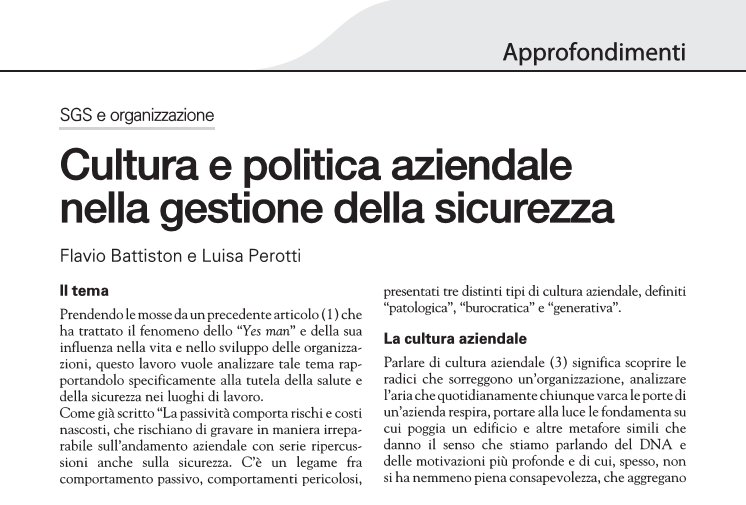
di Flavio Battiston e Luisa Perotti
Vi segnalo questo interessante articolo, il seguito di Yes man, Salute e cultura della sicurezza, dove gli autori affrontano il tema della cultura aziendale, in relazione alla gestione della salute e della sicurezza. Mi sento particolarmente affine alla considerazione dalla quale partono:
Le aziende e più in generale le organizzazioni sono delle comunità con tutte le implicazioni sociologiche, psicologiche ed etiche che accompagnano tale termine. È il luogo in cui si manifestano i bisogni, ma anche il luogo in cui si attiva la rete che ne consente la risoluzione. Ciò che determina lo sviluppo della comunità è la condivisione intesa come possibilità offerta a ciascuno di dare il proprio contributo e di sopperire alle mancanze del singolo che sono anch’esse condivise.
La cultura della tutela della salute e della sicurezza si è evoluta da un approccio fatalistico – quando era scontato che nella vita lavorativa di particolari gruppi di lavoratori occorresse un incidente, per cui gli sforzi erano volti a mitigare gli esiti di questi incidenti, con la nascita delle casse di mutuo soccorso – fino a sviluppare l’approccio contemporaneo, che prende in considerazione le modalità in cui è organizzato il lavoro e i ruoli e le responsabilità che vi sono connessi, inglobando ed estendendo la fase meccanicista, in cui l’incidente era la conseguenza di una anomalia tecnica.
Guardare alle organizzazioni ha reso necessario approfondire il modo in cui queste strutture vengono “popolate”, ovvero le comunità che si creano negli ambienti di lavoro. Questa è l’ultima frontiera da esplorare, e la lettura non superficiale degli standard dei sistemi di gestione ci sta portando in questa direzione.
HSE Manager Wolters Kluwer Italia: Piani di emergenza e contingency plan | LinkedIn
Sarebbe stato bello, in questa contingenza di #COVID19, avere un piano da seguire: avere definito i possibili scenari ed individuato le possibili contromisure, in maniera da non rendere necessario perdere tempo a per mettersi d’accordo, quando i contagiati raddoppiano ogni dieci giorni, ma forse ogni sette o ogni cinque.
Leggi il post su HSE Manager Wolters Kluwer Italia: Piani di emergenza e contingency plan | LinkedIn
ISO 45001 and COVID-19 part one – HSE People

Does an organization that has implemented an OHS management system according to the ISO 45001:2018 standard, needs to learn a lesson from what happened to it, because of the COVID-19 epidemic? Certainly. The decision to adopt a management system is made on a voluntary basis; there are no laws that impose it. Those who have taken this step did so because they intended to undertake a virtuous path, which detaches them from the ground of the minimum regulatory requirements defined for the protection of the psychophysical integrity of the worker, with the aim of accessing a higher level of good practices. And it is certainly a good practice to evaluate what has changed since December 31, 2019, when the World Health Organization collected a statement from the Municipal Health Commission of Wuhan, in the People’s Republic of China, relating to cases of viral pneumonia.
To be precise, the management system should have given itself a process for controlling the change, even if the requirement 4.1.3 foresees the need to keep under control the planned changes, temporary and permanent, which have an impact on the performance of the OSH. in terms of organization and working conditions, however, there remains a need to re-examine the consequences of involuntary changes.
We are therefore in the situation in which our organizations have had to take countermeasures in a hurry as a result of the epidemic, very often under impromptu instructions, and must now plan a coexistence with the virus that is expected to be long and complicated. How to operate to make the most of the management system? The most powerful tool in this regard is the management review, defined in requirement 9.3 of the standard. This is a step that usually marks the conclusion of a Deming cycle and the start of a new one, but nothing prevents it from being used for a new planning of activities, as a consequence of an epochal event such as the one we are experiencing.
In this case, the main topic to be evaluated is listed under letter b) of the content list of a typical management review: changes in internal and external factors that are relevant to the management system for OSH. And then we return to requirement 4: the context of the organization.
Photo by Anna Shvets from Pexels. Originally published on HSE People.
Il contact tracing COVID-19 e il lavoro dell’Istituto Superiore di Sanità – Teknoring

Tra criticità legate alla privacy, complessità dei dispositivi normativi e barriere tecnologiche, il tracciamento è una delle questioni più difficili nella gestione della pandemia. Come si muove l’ISS e cosa si potrebbe fare?
Leggi l’articolo Il contact tracing COVID-19 e il lavoro dell’Istituto Superiore di Sanità su Teknoring
Una questione culturale: HSE Manager Wolters Kluwer Italia | LinkedIn

Un progetto aggiornato deve considerare, assieme alle specifiche tecniche dell’oggetto da costruire, anche i criteri da seguire per la programmazione dei lavori in sicurezza e per la sua gestione ambientale sostenibile, e chi considera questi aspetti in contrasto con l’attività di costruzione è irrimediabilmente inadeguato a gestirlo.
Leggi il post su HSE Manager Wolters Kluwer Italia: Una questione culturale| LinkedIn
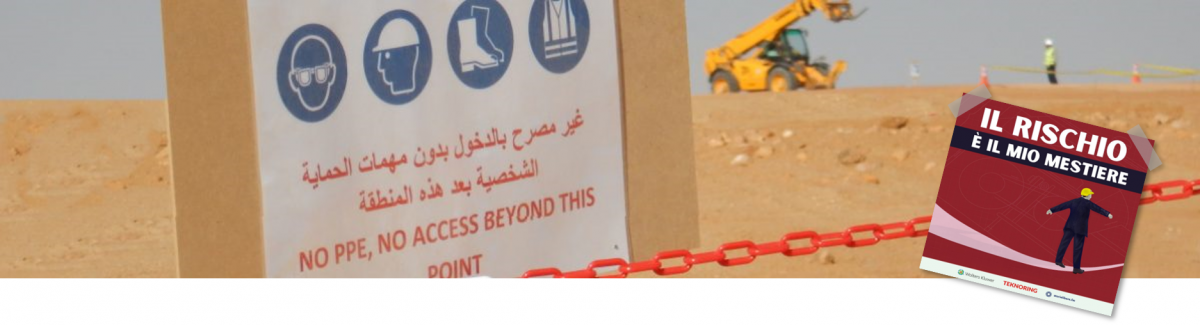
 No PPE, no access beyond this point